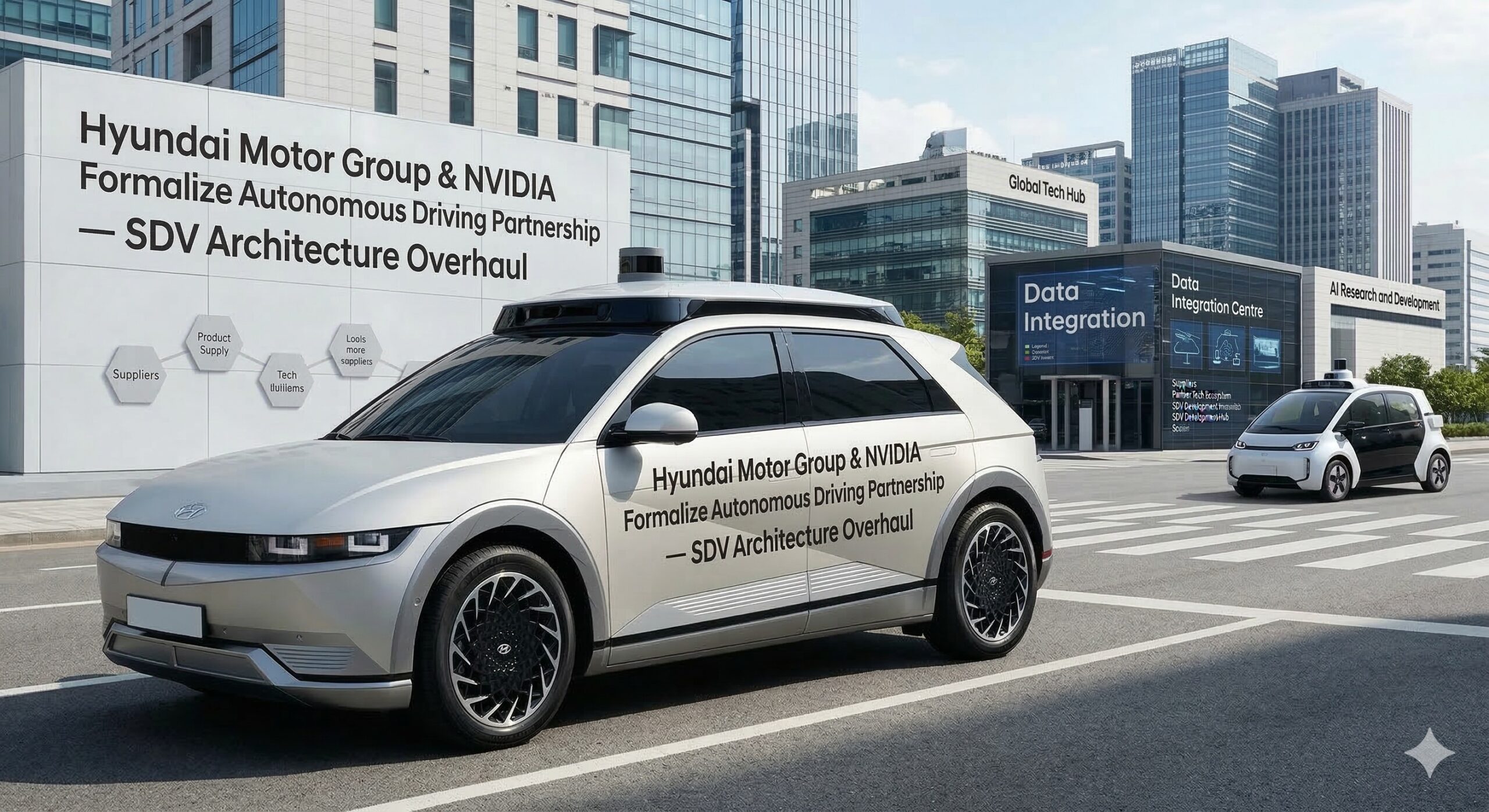
Hyundai Motor and Kia have officially expanded their strategic collaboration with NVIDIA, targeting the full spectrum of autonomous driving — from Level 2 Advanced Driver Assistance Systems (ADAS) to Level 4 robotaxi services. The partnership marks a pivotal policy and technology milestone that is expected to reshape how South Korea’s automotive sector approaches software-defined vehicle (SDV) development and regulatory compliance.
■ Regulatory & Industry Impact: SDV Transition Becomes an Imperative
At the heart of the agreement is Hyundai Motor Group’s adoption of the NVIDIA DRIVE HYPERION platform — a scalable reference architecture that integrates high-performance CPUs, GPUs, cameras, and sensors into a unified hardware-software framework capable of supporting autonomous driving from Level 2 through Level 4. By building its proprietary SDV architecture on top of this standard, Hyundai Motor Group is signaling a decisive move away from hardware-centric vehicle development toward an AI- and software-first paradigm. For South Korea’s broader automotive supply chain, this transition is no longer optional; it represents an emerging industry standard that suppliers and partners must align with.
■ Compliance Considerations: Data Pipelines and Safety Certification in Focus
The partnership entails the construction of a data flywheel — a continuous cycle of visual, linguistic, and behavioral data collection, AI model training, real-world vehicle deployment, and data quality improvement. Hyundai Motor Group plans to consolidate data generated across all group entities into a single, unified training pipeline. From a compliance standpoint, this raises significant questions around South Korea’s Personal Information Protection Act (PIPA) and the Motor Vehicle Management Act, particularly concerning the collection, storage, and use of driving data. For Level 4 robotaxi commercialization, meeting the Ministry of Land, Infrastructure and Transport’s autonomous vehicle safety standards and securing operational permits will be prerequisites, making regulatory readiness a critical bottleneck.
■ Industry Response: Suppliers and Startups Must Accelerate SDV Readiness
The ripple effects of Hyundai Motor Group’s decision extend across the domestic automotive ecosystem. Tier 1 and Tier 2 suppliers operating under traditional hardware-delivery models face pressure to rapidly develop software interoperability and data integration capabilities. As Motional — the U.S.-based Level 4 robotaxi joint venture — moves into a more intensive phase of technical collaboration, demand for partnership with autonomous driving startups and platform providers is also expected to grow. Stakeholders should note, however, that the specific scope, structure, and timeline of the collaboration remain subject to separate contractual agreements between the parties, and business plans should be formulated accordingly.
■ Global Trends: Accelerating Regulatory Competition in Autonomous Driving
The global race for autonomous driving supremacy is intensifying on multiple regulatory fronts. The United States is advancing federal autonomous vehicle safety frameworks, while the European Union is developing an autonomous driving regulatory architecture linked to its landmark AI Act. China continues to strengthen smart vehicle policies centered on domestic automakers and tech giants. Hyundai Motor Group’s alliance with NVIDIA can be interpreted as a strategic effort to secure a foothold in technology standard-setting within this competitive international environment. For South Korea’s government, the partnership underscores the urgency of expanding regulatory sandboxes and special exemption schemes for autonomous vehicle testing and commercialization to sustain the industry’s global competitiveness.