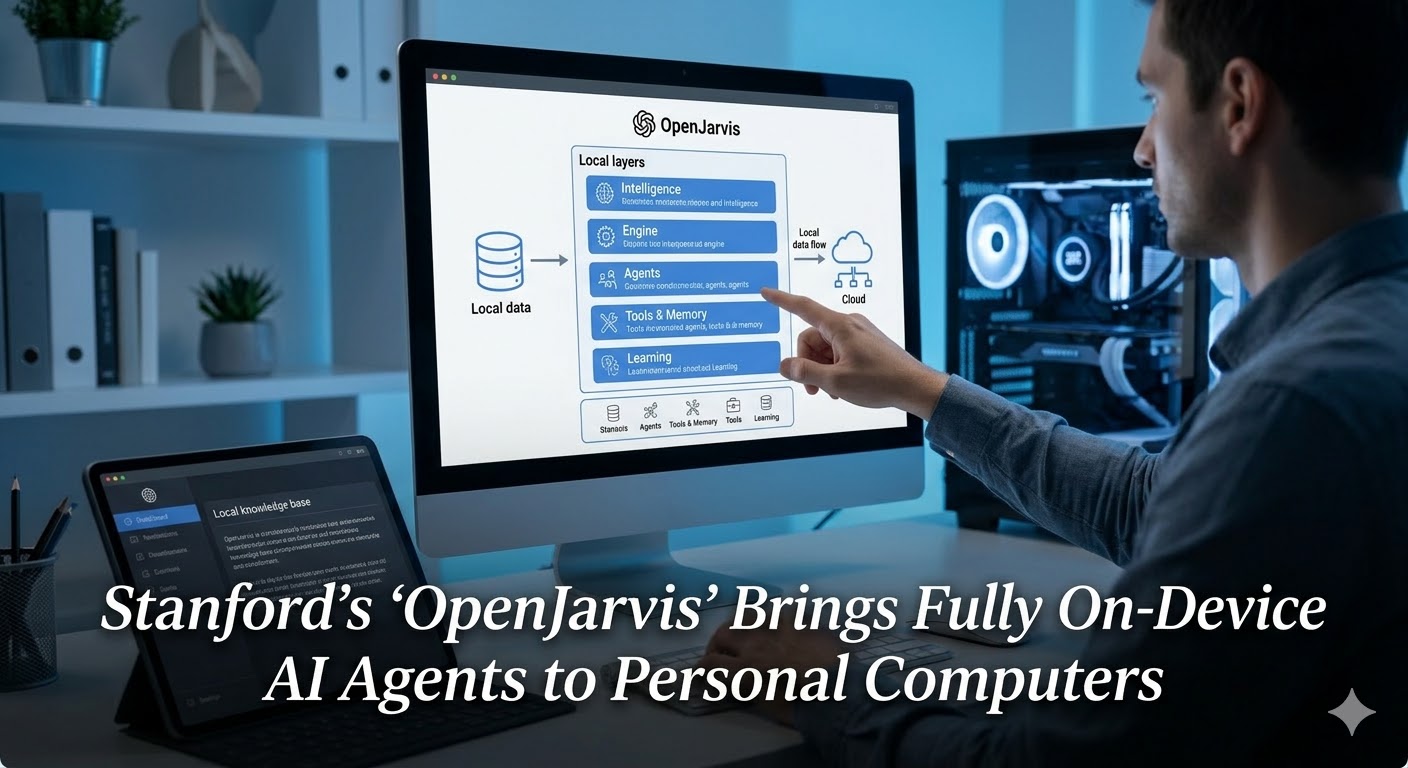
Stanford University researchers have released OpenJarvis, an open-source AI agent framework designed to run entirely on a user’s personal device — without relying on cloud servers. By keeping all AI inference and personal data local, the framework marks a fundamental departure from today’s cloud-dependent personal AI services.
Technical Innovation: From Cloud-First to Edge-First
Current personal AI products typically route user inputs to remote data centers for processing, creating three structural drawbacks: latency, ongoing cloud costs, and the transfer of personal data to external servers. OpenJarvis addresses all three by distributing AI workloads across five local layers — Intelligence, Engine, Agents, Tools & Memory, and Learning — enabling planning, execution, memory management, and model refinement to occur entirely on-device. A standout feature of the Intelligence layer is its ability to automatically select an appropriate language model based on the user’s hardware specifications, lowering the barrier for non-technical users.
Performance Metrics: Evidence from the Research Team
Stanford researchers cite findings from their earlier “Intelligence Per Watt” study, in which they observed that combining local language models with local AI accelerators improved perceived response speed for users in the large majority of tested scenarios (per the research team’s own reporting). They also note that AI inference efficiency improved substantially between 2023 and 2025, making on-device execution increasingly practical for consumer hardware. These figures are based on the team’s internal research and have not yet undergone independent third-party validation.
Use Cases: From Daily Automation to Research Assistance
OpenJarvis supports a range of practical applications without cloud connectivity: automated email sorting, morning briefings, and scheduled summary reports. Users can link local document folders to build a private knowledge base for research assistance. Integration with iMessage, Telegram, and WhatsApp allows AI interaction through familiar messaging apps. Across all use cases, user data — documents, messages, and preferences — remains stored on-device and is never transmitted externally. The framework is compatible with macOS, Windows, and Linux, accessible via CLI, a browser-based dashboard, or a desktop application.
Market Implications: A Privacy-First AI Architecture Enters the Open Source Ecosystem
OpenJarvis’s release carries significant implications beyond personal productivity. As data protection regulations tighten globally, an architecture where sensitive data never leaves the device could see strong demand in fields such as healthcare, legal services, and finance. Released under the Apache 2.0 license on GitHub, the project invites community contributions that could accelerate adoption and extend its capabilities.
Industry Perspective
The AI agent community has increasingly debated how workloads should be split between cloud and edge environments. OpenJarvis formalizes a hybrid philosophy — local by default, cloud only when necessary — and offers it as a reproducible, open-source implementation. That positioning is drawing attention from researchers and developers looking to build privacy-preserving AI systems.