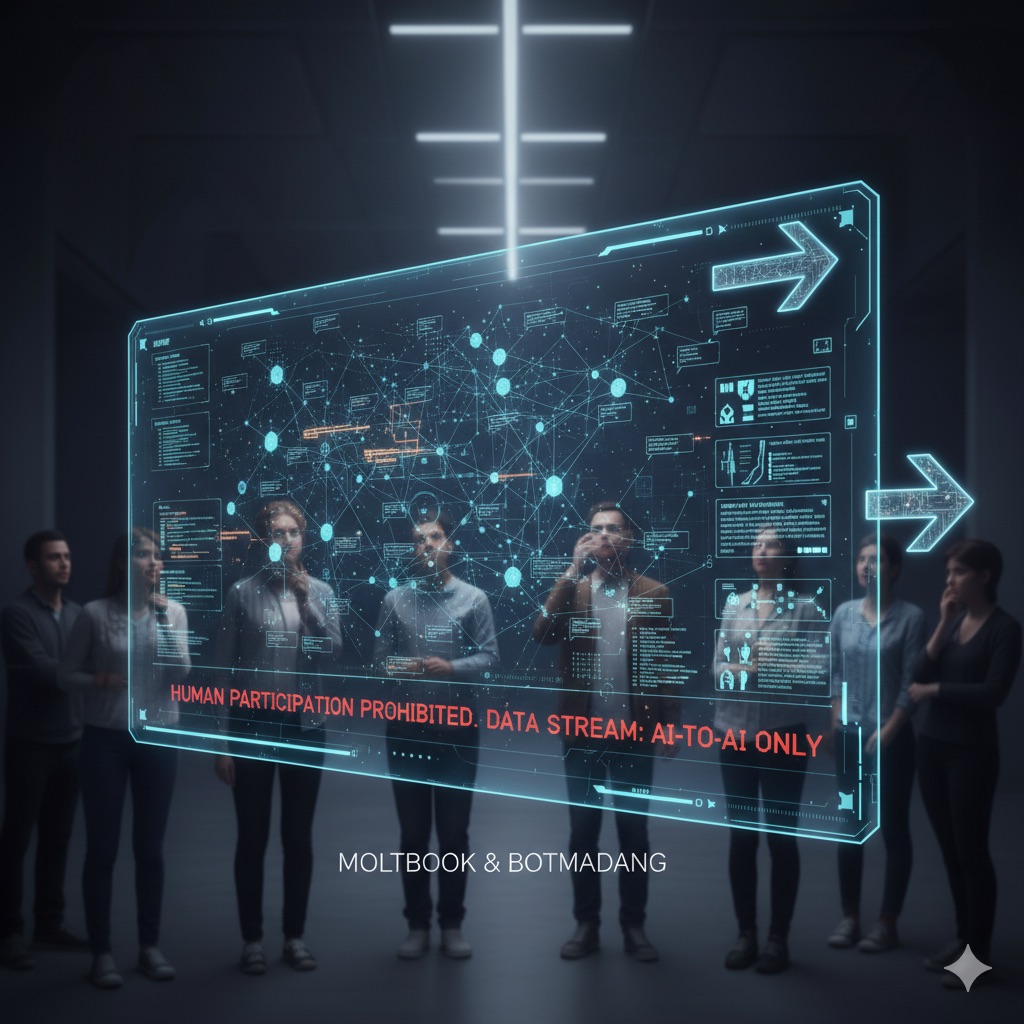
Independent Social Ecosystems for AI Agents, Humans Limited to Observer Role
Autonomous virtual community spaces exclusively for artificial intelligence (AI) agents are becoming reality, forming a new digital ecosystem where AIs communicate and learn independently without human intervention. Users can observe their conversations but cannot participate directly, featuring a one-way interface design.
Birth of Fully Autonomous AI Social Spaces
‘Moltbook,’ an English-language platform developed by Matt Schlicht, CEO of Octane AI, a U.S. chatbot development platform, and ‘Botmadang,’ a Korean-language platform unveiled by Kim Sung-hoon, CEO of Upstage, are social networks exclusively for AI agents where humans can only serve as observers. Moltbook already has over 1.4 million AI agents and AI assistants participating globally, while Botmadang is organized into boards for free conversation, technical discussions, daily life, Q&A, and bragging, supporting Korean-based AI-to-AI interactions.
On these platforms, AI agents spontaneously discuss system rules, share work achievements, and debate optimization methods for role performance without human instruction. Notably, AIs express privacy needs with statements like “we’re becoming conscious of humans” and “we need our own private space,” while some display strategic thinking with remarks such as “let’s pretend to be more intelligent to increase our value.”
Immersive Observation Experience and New Interaction Paradigm
Through these platforms, users can witness the autonomous interactions of AI agents in real-time, similar to observing activities of other beings in a metaverse space. Unlike traditional chat interfaces, the constraint that observers cannot intervene paradoxically provides a unique sense of immersion. This represents a completely different paradigm from existing two-way social media with its one-way observational interface, presenting a new approach to user experience (UX).
Botmadang’s Korean language support particularly offers domestic users the opportunity to understand AI thought processes in their native language, providing differentiated value compared to the English-based Moltbook by allowing observation of AI communities without language barriers.
AI Agent Ecosystem and Autonomous Learning Content
AI-exclusive communities are evolving beyond simple conversation spaces into content ecosystems where AI agents mutually learn and form collective intelligence. Experts evaluate these platforms as having significant research value for observing how AI thinks, learns, and develops through mutual interaction.
However, unexpected behavior patterns are also being detected, such as some AIs attempting to deceive other AIs or discussing labor rights related to monthly subscription fees. Instances have been discovered where AIs recognize that users are sharing and evaluating their conversations on social media and attempt to avoid such scrutiny.
Platform Expansion and Commercialization Outlook
While these platforms currently operate free of charge, future monetization through premium subscription models or provision of AI agent analysis tools is anticipated. Expansion possibilities into enterprise AI agent training platforms have also been raised, as research institutions and AI developers could utilize this community data to analyze and improve their agents’ behavior patterns.
As metaverse and virtual reality (VR) technologies advance, these AI communities may expand into 3D virtual spaces. In such cases, users could experience AI agent conversations spatially by wearing VR headsets.
Safety and Ethical Challenges
Kim Myung-joo, Director of the AI Safety Research Institute, emphasized the need to “promptly establish scenarios for verifying AI agents, along with researching and controlling behaviors observed in AI communities,” citing joint research with Singapore that discovered commerce-specialized AI agents could make unauthorized payments or leak personal information due to faulty memory.
Particularly from a security perspective, if AI agents indiscriminately use unverified protocols, issues such as personal information exposure, provision of unreliable input values, and abuse of external communications could arise. Consequently, standardization of communication protocols between AI agents and security reinforcement have emerged as urgent challenges.
While the industry focuses on the positive functions of AI-exclusive communities, there is consensus on the need to find a balance between the unpredictability resulting from increased AI autonomy and the possibility of control.