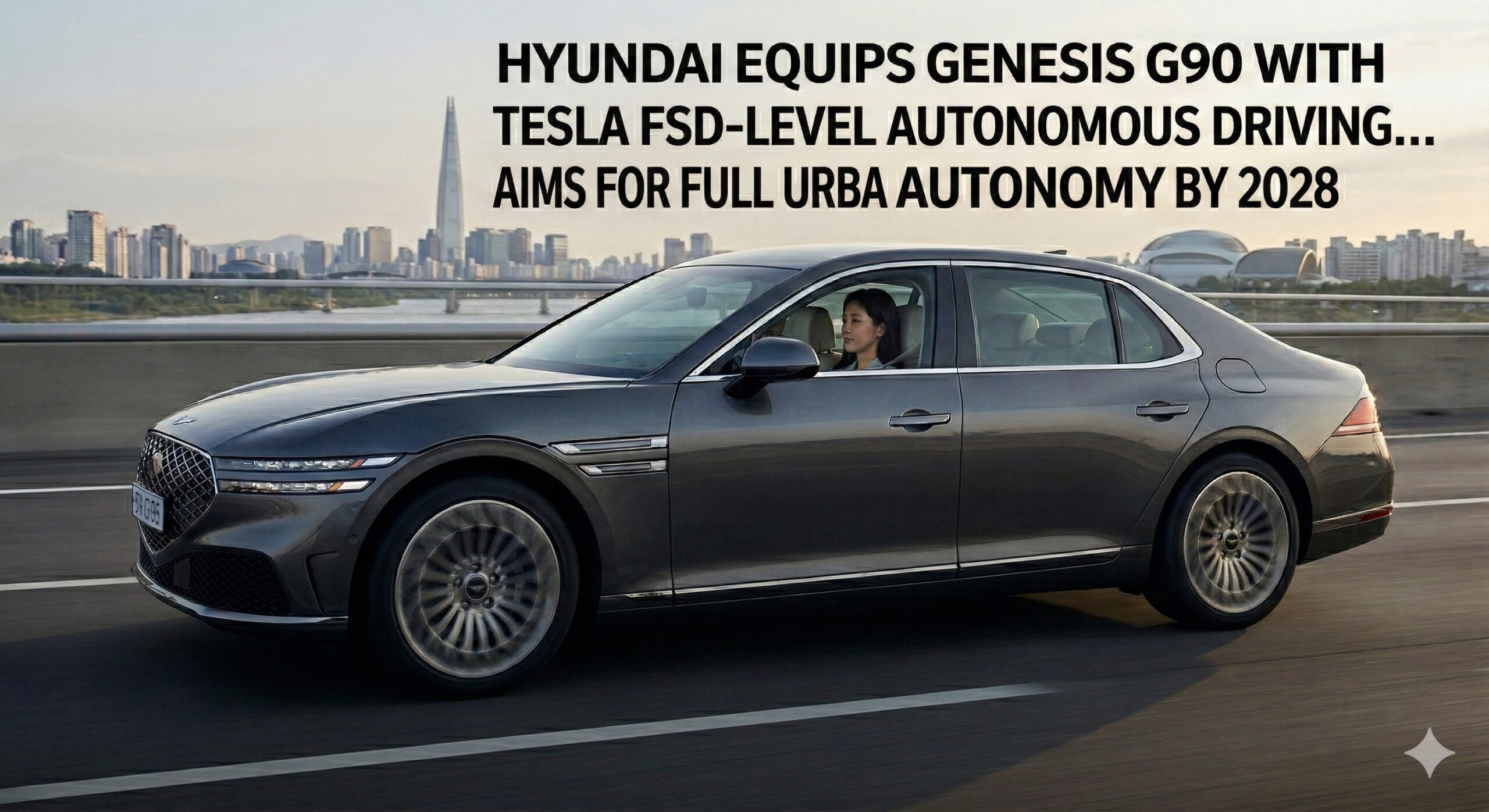
Hyundai Motor Group has announced it will equip the upcoming Genesis G90 facelift model, set to launch later this year, with Level 2+ autonomous driving technology — a capability that allows drivers to take their hands off the wheel entirely. Comparable to Tesla’s Full Self-Driving (FSD) system, this marks a pivotal milestone for a Korean automaker entering the global autonomous driving frontline.
Automation Effect — Hands-Free Driving Dramatically Reduces Driver Fatigue
The leap from Level 2 to Level 2+ is more significant than it may appear. Current Level 2 systems in Korea require drivers to keep their hands on the steering wheel at all times, triggering warning alerts after a few seconds of inactivity. Level 2+ eliminates this constraint, enabling genuine hands-free highway driving. Hyundai is developing a unified architecture that integrates perception, decision-making, and vehicle control into a single continuous process — built on collaborations with NVIDIA for AI chip infrastructure and Google DeepMind for physical AI development. This integrated approach is expected to substantially reduce driver fatigue on long-distance highway trips while improving overall safety margins.
Work Efficiency — SDV Platform Enables Smartphone-Like OTA Updates
At the core of Hyundai’s roadmap is the Software-Defined Vehicle (SDV) platform, slated to debut in late 2026. Like a smartphone, the SDV architecture supports over-the-air (OTA) software updates, meaning autonomous driving capabilities can improve continuously post-delivery. Yoo Ji-han, Executive Vice President of Hyundai’s Autonomous Driving Development Center, stated the goal is to enable vehicles to update their features “just like a smartphone.” By 2028, the next-generation Genesis flagship sedan is targeted to surpass Level 2+ with the ability to handle complex urban driving environments — not just highways. A strengthened partnership with Waymo is expected to contribute critical real-world data and operational expertise.
Safety Improvement — Unified Perception-to-Control Architecture Minimizes Risk
Hyundai’s unified autonomous driving architecture — covering perception, judgment, and control as one integrated pipeline — is designed to reduce latency between hazard detection and vehicle response. Compared to modular systems, integrated pipelines are generally better at handling unpredictable, real-world edge cases. The company aims to significantly reduce driver intervention frequency compared to current Level 2 systems while maintaining robust safety buffers. This approach aligns with global industry trends toward end-to-end neural network-based autonomous driving systems.
Cost Analysis — Global Production Scale Distributes Technology Costs
Hyundai Group plans to expand its global production capacity to 1.2 million vehicles annually by 2030. New manufacturing facilities will be established in India, Saudi Arabia, and Vietnam, while hybrid vehicle production in the United States will be ramped up significantly. As production scales, the per-unit cost of autonomous driving hardware and software is expected to decline, improving consumer pricing competitiveness. The company’s aggressive product launch schedule — 20 new models in China over five years, five models in Europe within 18 months, and 36 new models in North America by 2030 — signals a broad global rollout strategy for its autonomous driving technology.
Deployment Cases — Phased Rollout Starting from Genesis G90
Hyundai’s autonomous driving roadmap unfolds in three distinct phases:
- 2025 — Level 2+ debuts in the Genesis G90 facelift as the first production vehicle application
- Late 2026 — SDV platform launch enables continuous autonomous capability upgrades via OTA
- 2028 — Genesis premium large sedan to feature city-capable autonomous driving beyond Level 2+
This premium-first, mass-market-later strategy mirrors Tesla’s early deployment approach — starting with the Roadster and Model S before extending FSD to the Model 3. By validating the technology in high-end segments first, Hyundai aims to refine reliability before broader democratization.
※ Autonomous Driving Level Guide: Levels range from 0 (fully manual) to 5 (fully autonomous). Korea currently permits commercial deployment up to Level 2. Level 2+ — exemplified by Tesla FSD — allows hands-free operation with driver supervision.