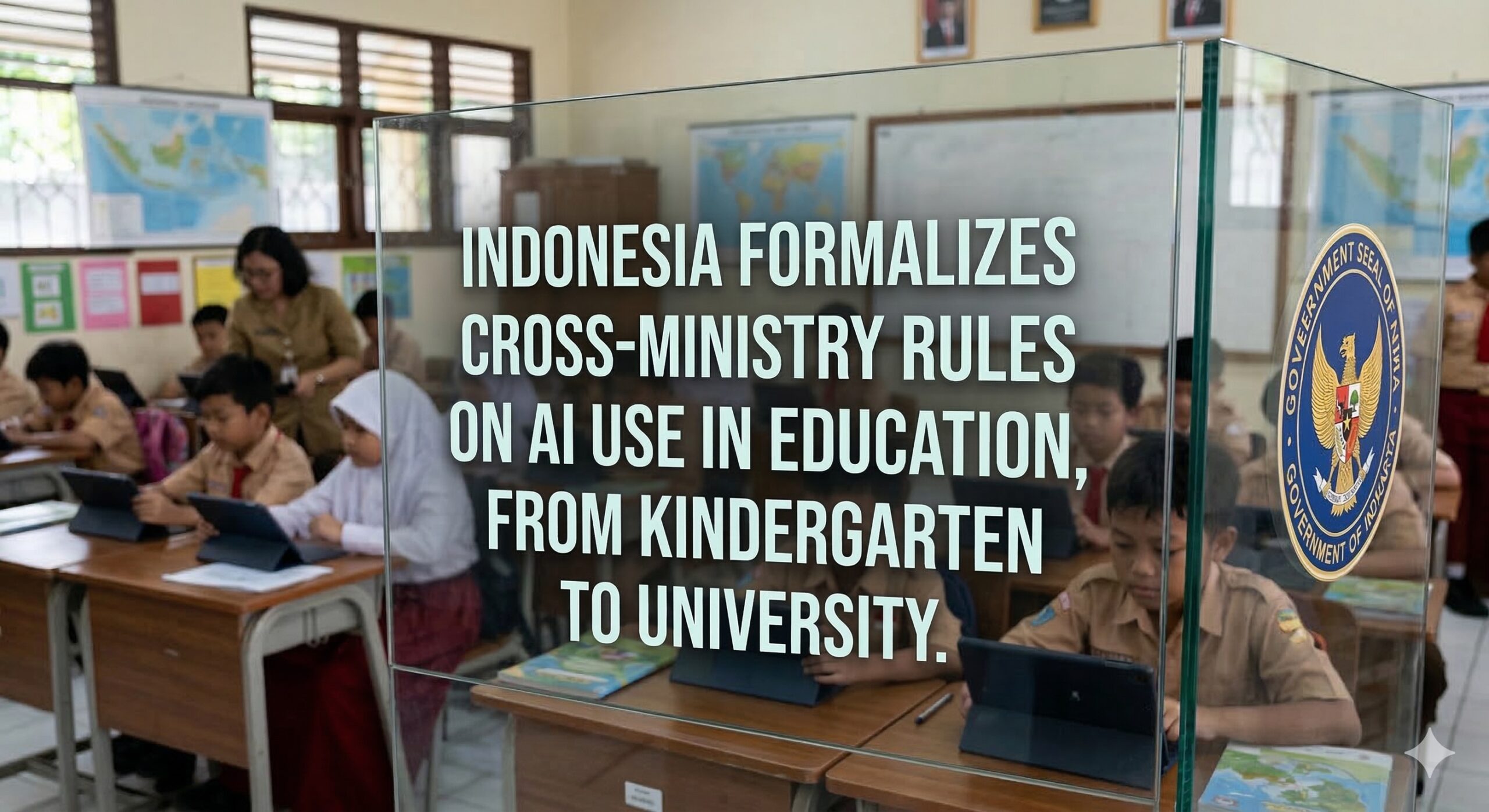
Indonesia has moved to regulate the use of artificial intelligence and digital technology across its entire education system, from early childhood programs through higher education. A joint ministerial decree signed on March 12, 2026 by seven cabinet ministers establishes a tiered framework designed to harness the benefits of AI-powered learning tools while protecting students from potential harms.
Regulatory Impact
The decree introduces age-differentiated rules governing the minimum age for technology use, permitted categories of digital tools, and recommended screen time limits—each calibrated to the developmental stage of the student. At the primary and secondary levels, general-purpose AI applications that auto-generate answers to user queries are prohibited outright. Exceptions exist for AI tools specifically engineered for structured educational objectives, such as robotics simulations. The strictest controls apply to early childhood and primary learners, covering both content types and screen time, while rules become progressively more flexible at the higher education level.
Compliance Requirements
Educational institutions and edtech providers will need to align their offerings with grade-specific usage criteria. Products marketed as AI for education will likely require validation to demonstrate compliance with the decree’s intent. Detailed implementation guidelines are expected to be published separately; in the interim, institutions must assess their current tools against the framework’s stated categories and restrictions.
Industry Response
Edtech stakeholders see a dual implication in the policy. On one hand, the outright ban on generic AI chatbots in schools narrows the addressable market for general-purpose AI tool providers. On the other, it creates a structural opportunity for companies developing purpose-built, curriculum-aligned AI platforms. Concerns remain around equity—whether schools in lower-resource regions will have access to approved educational AI tools at all.
International Trends
Indonesia’s move reflects a growing global consensus that AI governance in education cannot be left to individual institutions or market forces. The EU’s AI Act classifies AI systems targeting minors as high-risk, requiring rigorous oversight. The UK and Australia have introduced or tightened restrictions on smartphone and AI use in schools. What distinguishes Indonesia’s approach is its cross-ministerial coordination—seven departments, spanning education, communications, child protection, and family affairs, co-authored the decree—signaling a whole-of-government stance that other developing economies may look to as a reference model.