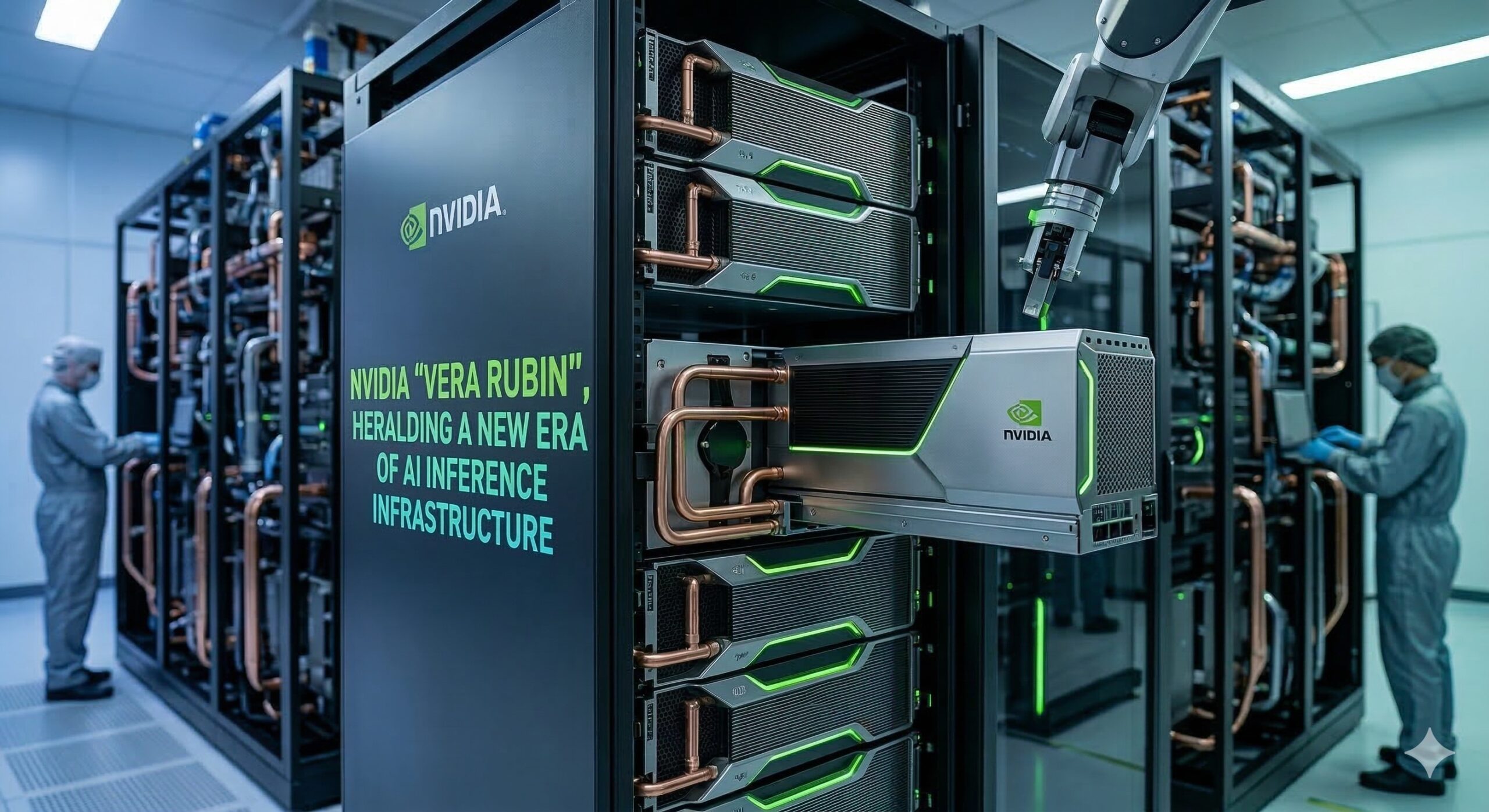
NVIDIA unveiled its next-generation AI data center platform, ‘Vera Rubin,’ at GTC 2026, signaling a decisive shift in AI architecture from model training to large-scale inference deployment. CEO Jensen Huang projected that the AI computing infrastructure market will reach a minimum of $1 trillion by 2027 — more than double the estimate he offered just one year prior.
Technical Innovation Vera Rubin represents a fundamental rethinking of data center architecture. Rather than connecting discrete servers in a cluster, the platform integrates CPU, GPU, networking, and data processing units (DPUs) into a single cohesive system capable of linking up to 144 GPUs as one unified AI supercomputer. The platform also introduces liquid cooling technology that improves power efficiency and reduces server deployment time — from roughly two days down to approximately two hours.
Performance Metrics A key component of the announcement was ‘Groq,’ a dedicated AI inference chip co-designed with NVIDIA. Unlike conventional AI accelerators that rely on High Bandwidth Memory (HBM), Groq employs high-speed SRAM to minimize data processing latency. Chips are shipped in 8-unit modules, manufactured by Samsung Foundry, with initial shipments expected in Q3 of this year. Huang emphasized that data centers built on Vera Rubin are designed to generate substantially higher economic returns compared to existing systems.
Use Cases The platform’s applications extend well beyond the data center. In the space domain, NVIDIA introduced the ‘Space-1’ computing module for satellite deployment, enabling companies like Planet Labs to process satellite imagery directly in orbit for climate analysis and disaster response. On the ground, NVIDIA is partnering with Hyundai Motor Group, BYD, Nissan, Geely, and Uber to launch a commercial robotaxi service in Los Angeles and San Francisco, targeting a 2027 debut.
Market Impact Huang characterized the robotics sector as a potential $50 trillion market over the long term — a figure that underscores NVIDIA’s ambitions beyond semiconductors. The company is rapidly repositioning itself as a full-stack AI platform provider spanning infrastructure, software agents, autonomous vehicles, robotics, and space computing. This strategic expansion is poised to intensify competition across global AI infrastructure investment.
Industry Response OpenAI CEO Sam Altman stated that NVIDIA’s infrastructure enables the company to push the boundaries of AI, noting that Vera Rubin will support faster and more reliable services for hundreds of millions of users. Anthropic CEO Dario Amodei echoed this sentiment, highlighting the platform’s computing, networking, and system design capabilities as key to delivering safer, more dependable AI services.