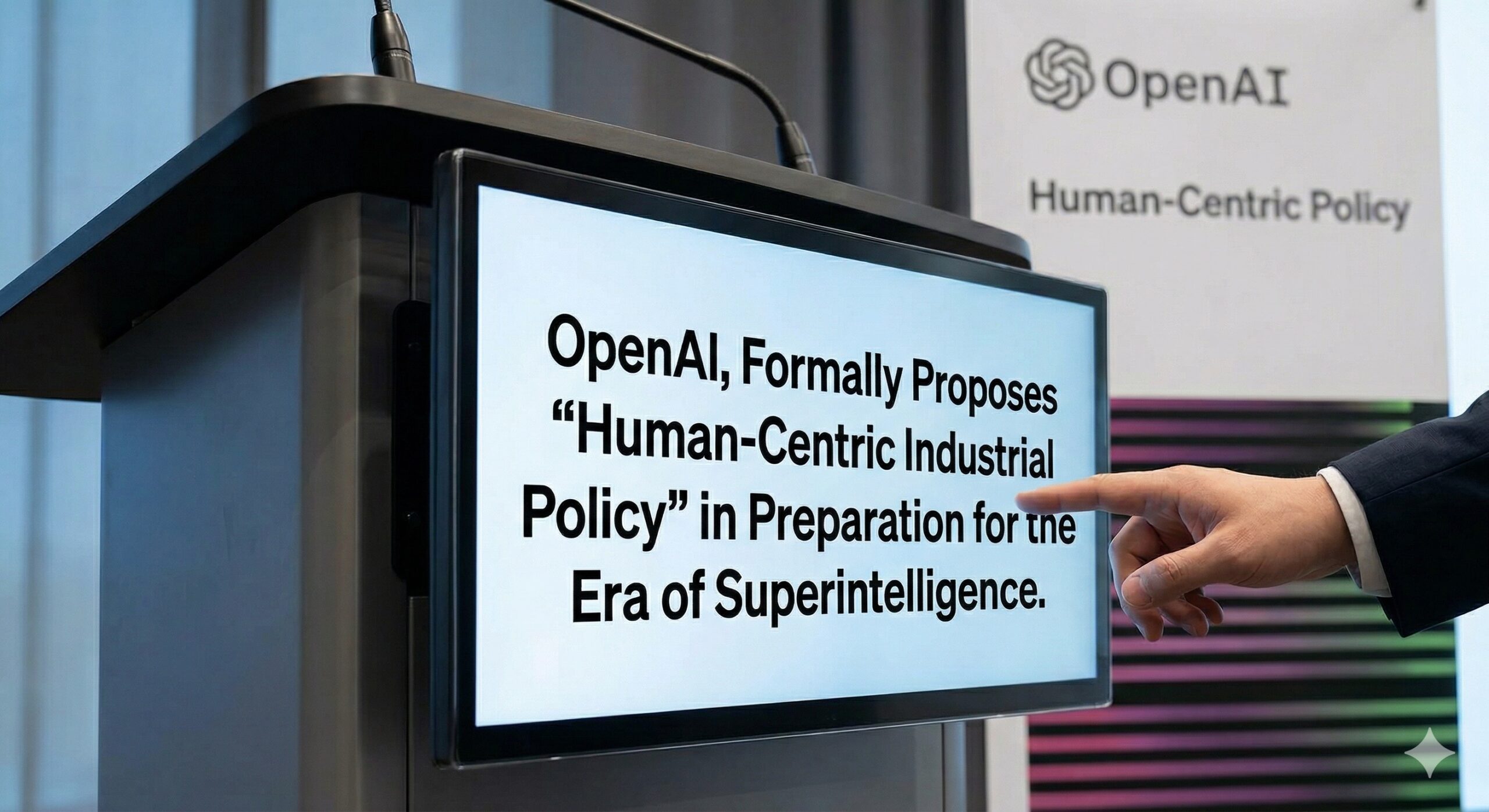
OpenAI, the maker of ChatGPT, has officially released a policy proposal aimed at distributing the economic gains of artificial intelligence more broadly across society, as it anticipates the arrival of superintelligence — AI systems that surpass human-level capabilities. Core proposals include a robot tax, a pilot program for a 32-hour four-day workweek without pay cuts, and the creation of a public wealth fund.
A Paradigm Shift in Tech Policy Advocacy
Published on April 6, 2026 under the title “Industrial Policy for the Intelligence Age: Human-Centered Ideas,” the document argues that incremental policy adjustments are no longer sufficient in the face of accelerating AI transformation. What makes this proposal distinctive is that an AI developer — itself a key driver of disruption — is calling for taxation and regulation of its own industry. OpenAI explicitly acknowledges that AI could increase corporate profits while reducing labor’s share of income, thereby eroding national tax bases: a structural risk the company is now urging policymakers to address.
Key Figures and Metrics
The proposal specifies a pilot 32-hour, four-day workweek, a research grant of up to $100,000, and up to $1 million in AI usage credits for eligible researchers. Crucially, specific figures for the robot tax rate or the size of the proposed public fund remain unspecified, with details to be worked out through forthcoming dialogue. A follow-up workshop is planned for Washington, D.C. in May 2026.
Proposed Use Cases and Policy Mechanisms
To buffer labor market disruptions, OpenAI recommends expanding unemployment benefits and retraining programs so displaced workers can transition into roles in childcare, elder care, and community services — sectors where human connection is irreplaceable. A public wealth fund, modeled after Alaska’s Permanent Fund, is proposed to give citizens a direct stake in AI-driven economic growth even if they don’t participate in financial markets. On the safety front, the proposal calls for strengthening the authority of the AI Safety and Innovation Center (CAISI) to evaluate and monitor risks — including cyber and biosecurity threats — posed by advanced AI models.
Market and Industry Implications
The Wall Street Journal characterized the proposal as a balancing act between the Trump administration’s deregulatory stance on AI and the Democratic Party’s emphasis on social safety nets. The proposal arrives at a moment when policymakers worldwide are grappling with how to manage the economic externalities of rapid automation. For markets, it signals that leading AI companies are increasingly aware that unchecked disruption could undermine the very consumer base that sustains the broader economy.
Expert Perspective
OpenAI itself was careful to note that this document represents a “starting point for broad conversation, not a set of fixed answers.” The fact that an AI company of this scale is proactively placing questions of labor protection, wealth distribution, and governance onto the policy table marks a notable shift — one that suggests the industry recognizes its social obligations are no longer separable from its technical ambitions.