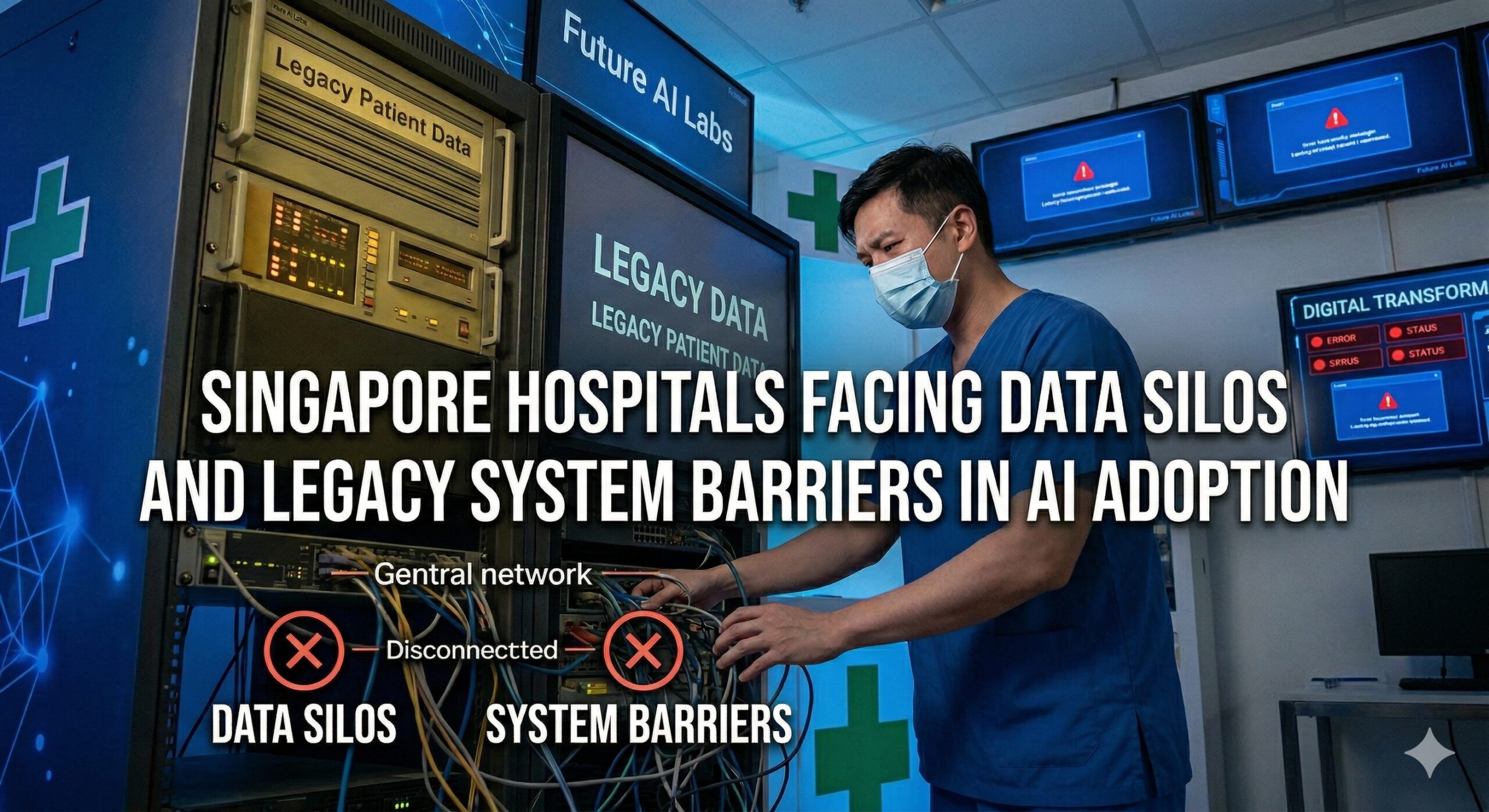
Singapore’s hospitals are confronting a widening gap between ambition and execution in AI adoption. Despite being one of Asia’s most digitally advanced healthcare systems, the city-state’s hospitals are discovering that deploying AI at scale is far more complex than piloting it in controlled environments.
Fragmented Data Remains the Core Barrier
Singapore’s public hospitals face five major challenges in AI and data science projects: fragmented data across systems with quality issues; strict data governance and security requirements; competing hospital priorities that force staff to prioritize clinical service demand; prohibitive costs for IT system integration; and change management difficulties in securing staff buy-in.
Across Southeast Asia, including Singapore, participants in research studies consistently cited unclean and unstandardized data, siloed databases, limited real-time data availability, and the burden of replacing legacy systems as the most pressing obstacles to meaningful AI deployment.
Legacy Infrastructure Limits AI’s Potential
When AI is layered onto outdated systems, its output will only ever be as strong — or as limited — as the foundation supporting it. IT leaders consistently cite skills shortages, particularly the scarcity of specialists who understand both legacy environments and modern architectures, as a major barrier to transformation. Healthcare, unlike other industries, operates with rigid legacy systems where even modest adjustments can affect entire clinical workflows, making the pace of modernization inherently slower.
Trust Gaps Compound Technical Challenges
In Singapore — a highly digitized and well-regulated environment where AI is used by around 80% of residents — trust drops sharply once AI advice moves into sensitive or emotionally charged domains like mental health. This trust deficit makes broad clinical adoption particularly difficult, even in areas where the technology has demonstrated clinical efficacy.
Government Response: Scaling Up Investment
Singapore’s Ministry of Health is moving decisively to address these structural gaps. MOH is injecting approximately SGD 200 million over five years into the MOH Health Innovation Fund to support AI innovation in public healthcare institutions, with a centralized push to scale proven use cases — starting with generative AI for routine clinical documentation and AI-powered medical imaging.
On the ground, results from selective deployments are promising. At Ng Teng Fong General Hospital, integrating patient-reported data with AI analytics led to a 45% increase in appropriate discharges from specialist outpatient care to primary care , demonstrating what AI can achieve when built on solid data foundations. The challenge now is replicating such outcomes system-wide — a goal that will require resolving the very infrastructure gaps that continue to slow Singapore’s AI ambitions.