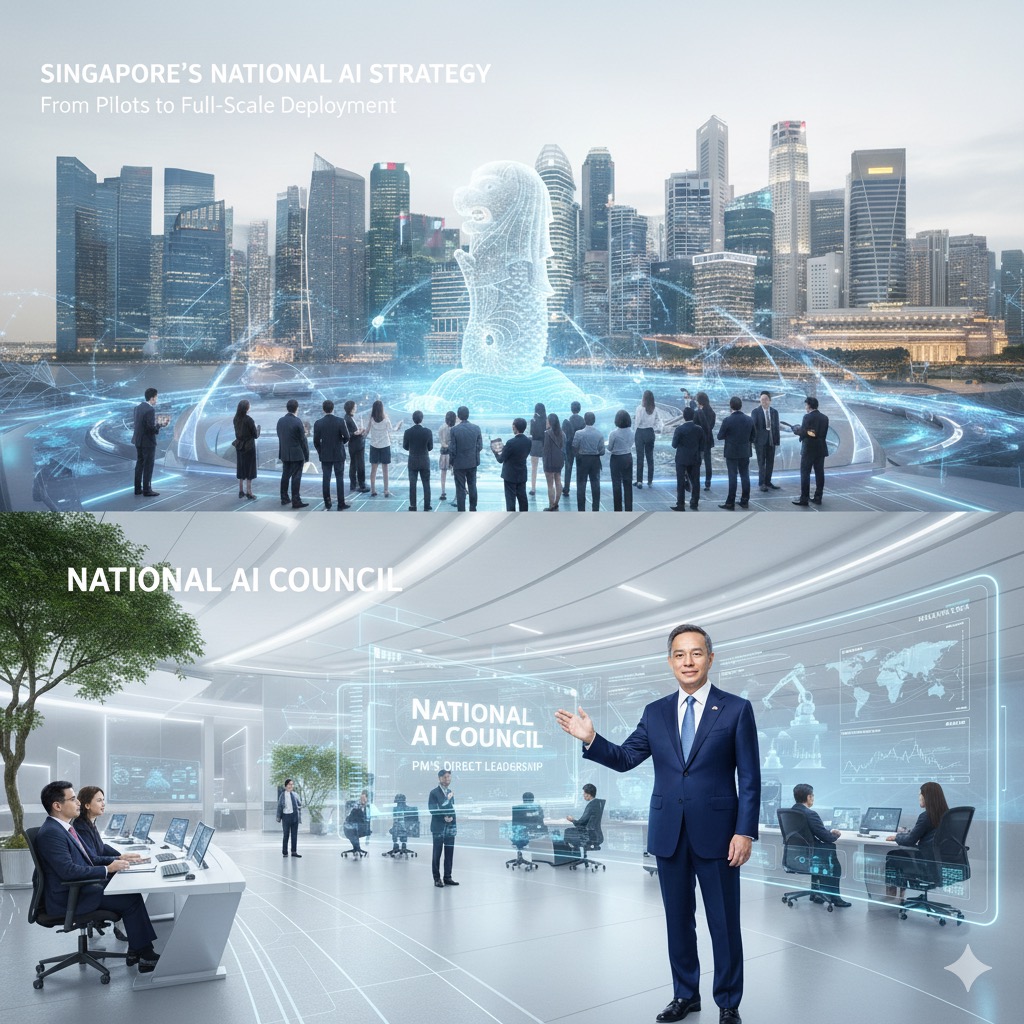
Singapore has elevated artificial intelligence to the status of core national strategy through its FY2026 Budget Statement, signaling a decisive shift from fragmented pilot initiatives to comprehensive, government-wide AI deployment. Prime Minister Lawrence Wong will personally chair the newly established National AI Council, directing AI adoption across four priority sectors: advanced manufacturing, connectivity, financial services, and healthcare.
Regulatory Impact and Structural Changes
The defining feature of this policy pivot is the elevation of AI governance from a ministry-level technology matter to a whole-of-government national agenda. The National AI Council will bring together ministers from the Trade and Industry, Health, Digital Development and Information, Manpower, National Development, and Transport ministries, alongside private sector representatives. This cross-ministerial structure is designed to dismantle bureaucratic silos and ensure that R&D investment, industry promotion, and regulatory frameworks operate in coherent alignment. Regulatory sandboxes will be deployed in parallel to enable controlled experimentation and de-risk innovation for industry players.
Compliance Requirements and Enterprise Support
A new “Champions of AI” program targets enterprises committed to comprehensive transformation—not piecemeal tool adoption. Qualifying companies will receive tailored support for end-to-end restructuring, including data governance redesign, process reengineering, and job function redefinition. On the fiscal side, the Enterprise Innovation Scheme will be expanded to allow companies to claim tax deductions of up to 400 percent on qualifying AI-related expenditures for the Years of Assessment 2027 and 2028, subject to a cap of S$50,000. JTC will also develop a large-scale AI Park at one-north to foster a co-innovation ecosystem linking startups, research institutions, and multinationals.
Industry Response and Workforce Strategy
Acknowledging potential labor market anxieties, the government has placed talent development at the core of its transformation agenda. The SkillsFuture platform will be revamped to improve discoverability and matching for AI-related courses, with participants in designated programs receiving six months of access to advanced AI tools. Critically, the TechSkills Accelerator (TeSA) program will be extended to mid-career workers from non-technology backgrounds—marking a shift in workforce policy from cultivating a narrow engineering elite to building broad-based human–machine collaboration competencies across the labor force.
International Context and Policy Implications
Singapore has charted a deliberately pragmatic course, explicitly acknowledging that it lacks the scale to compete with the United States or China in developing foundational AI models. Instead, its declared competitive advantage lies in deploying AI “effectively, responsibly, and swiftly.” This positions Singapore as a global test bed for AI solutions rather than a model-development powerhouse. Compared to the EU AI Act’s risk-tiered regulatory approach or the US’s largely industry-led framework, Singapore’s model represents a proactive, application-focused governance paradigm—one likely to serve as a policy benchmark for small and mid-sized economies across Asia navigating the AI transition.