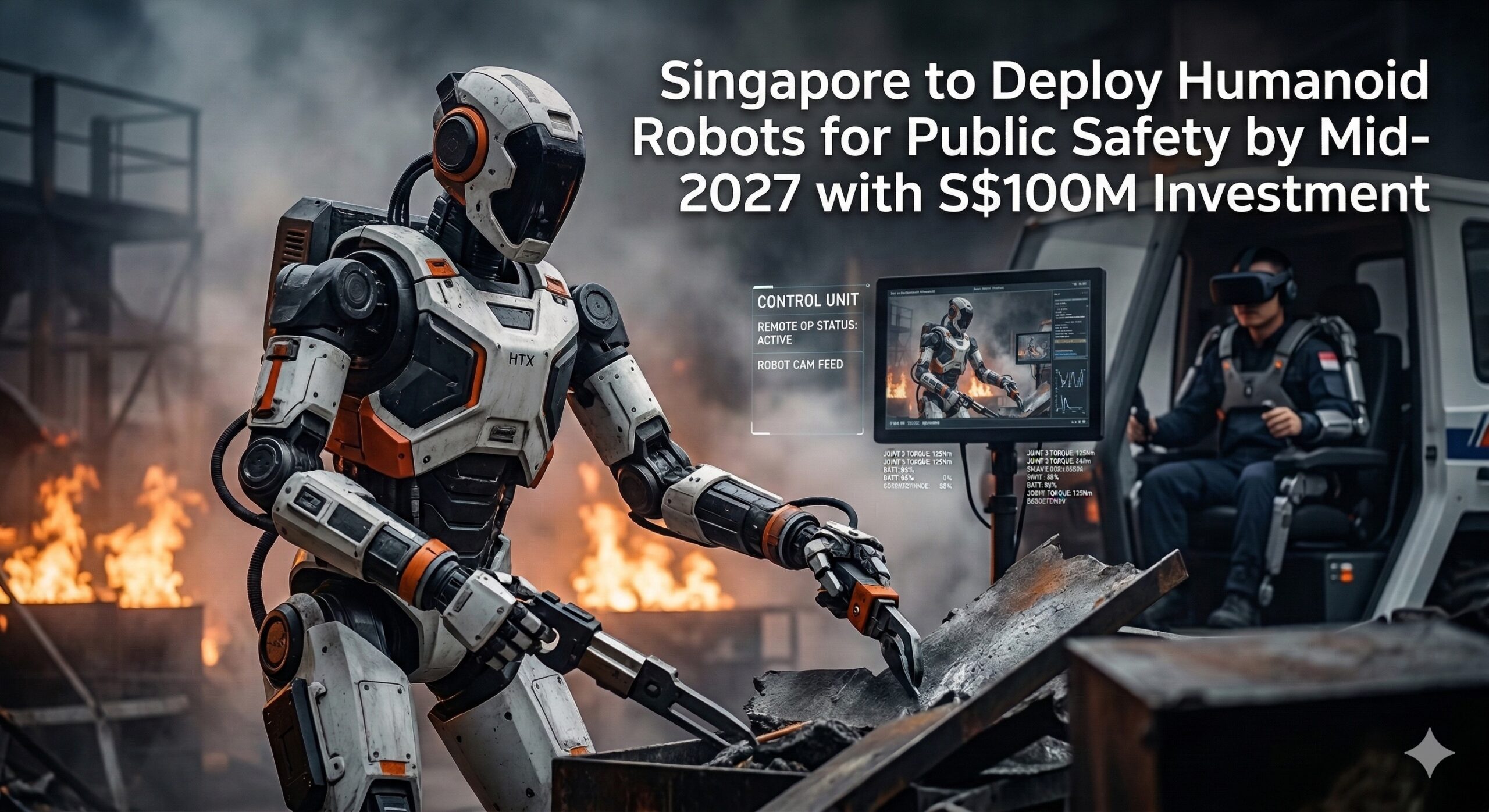
Singapore has announced plans to deploy humanoid robots in active public safety operations by mid-2027, targeting high-risk missions including firefighting, hazardous materials response, and search-and-rescue. The government will invest S$100 million to establish what is described as the world’s first robotics center dedicated exclusively to public safety applications.
Automation Effect The humanoid robots, developed by the Home Team Science and Technology Agency (HTX), will initially operate under remote human control. Operators wear an exo-suit that transmits motion data to the robot in real time, enabling it to replicate movements precisely. A paired VR headset allows the operator to see through the robot’s onboard cameras, providing situational awareness in hazardous environments. From 2029, the robots are planned to transition to AI-driven autonomous operation powered by Phoenix — HTX’s in-house large language model trained on Singapore’s linguistic and operational context, covering all four official languages.
Work Efficiency and Safety Improvement Four robots were showcased at HTX’s AI TechXplore exhibition: three standing approximately 1.7 meters tall and one smaller unit at roughly 0.9 meters. Their intended deployment covers the most dangerous frontline scenarios — precisely the environments where reducing human exposure matters most. HTX’s Chief AI Officer Ang Chee Wee stated that placing humanoid robots in realistic environments allows evaluation of how AI can complement officers and enhance safety. The shift from pre-programmed systems to GenAI-powered platforms is expected to dramatically improve adaptability when conditions on the ground change unpredictably.
Cost Analysis and Deployment Status The S$100 million investment will fund the Home Team Humanoid Robotics Centre (H2RC), slated to open by mid-2026 — a full year ahead of the robots’ field deployment. The facility will house dedicated zones for data collection, AI model training, and robotics development, backed by high-performance computing infrastructure. Minister for Digital Development and Information Josephine Teo framed the initiative as a necessary response to technology-enabled crime: law enforcement must be equipped not only to understand how technology is being misused, but to leverage it offensively in the public interest. Private security firm Certis also received its first humanoid robot around the same time, suggesting the shift is gaining traction beyond government agencies.
Deployment Track Record and Outlook Singapore’s Home Team has progressively expanded its robotic capabilities since deploying patrol robots at major events in 2018, subsequently developing the Rover-X robotic dog, cyborg cockroaches for disaster search-and-rescue in Myanmar, and drones now routinely used at public gatherings. The humanoid robot program represents a step-change — moving from purpose-built, task-specific machines toward general-purpose AI agents capable of autonomous judgment. With H2RC positioned as the world’s first facility of its kind, Singapore is setting a precedent for how governments integrate humanoid robotics into national public safety infrastructure.