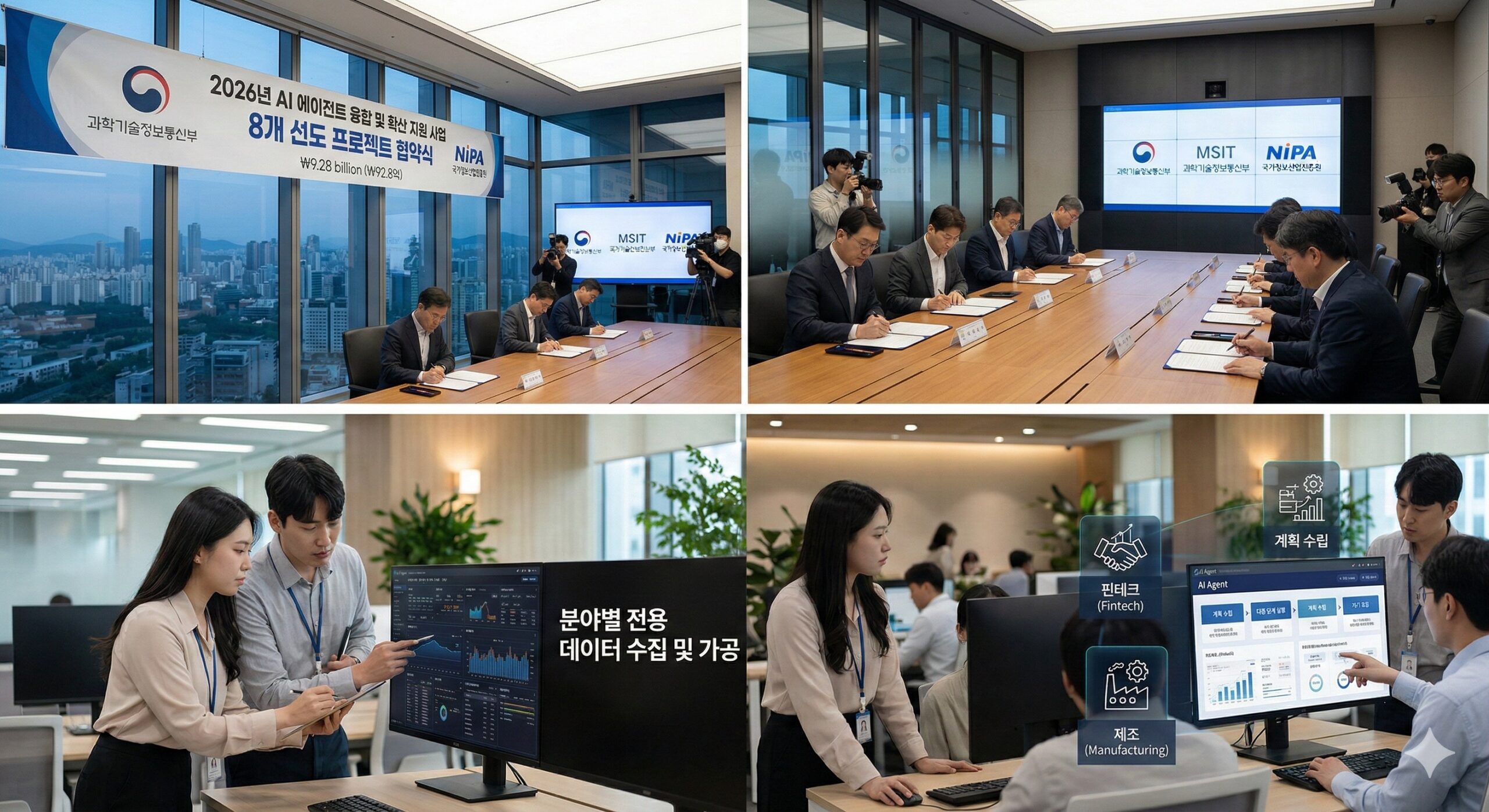
MSIT and NIPA launch two-year program covering the full pipeline from data collection to service validation
South Korea’s National IT Industry Promotion Agency (NIPA), in collaboration with the Ministry of Science and ICT (MSIT), has announced a new competitive grant program titled “2026 AI Agent Convergence and Diffusion Support.” The initiative will select eight specialized projects and fund the complete development lifecycle — from domain-specific dataset construction through deployment and real-world validation.
Technical Differentiation
Unlike previous government AI programs that primarily subsidized model development, this initiative takes an end-to-end approach. AI agents — autonomous systems capable of goal-setting, multi-step planning, and self-correction — require high-quality, domain-specific training data to perform reliably in industry contexts. By funding the data pipeline upstream, the program addresses one of the most persistent bottlenecks in applied AI deployment: the absence of clean, sector-relevant datasets.
Program Structure and Funding
Total government funding for 2026 is approximately ₩9.28 billion (roughly USD 6.8M at current exchange rates), with each selected project eligible for up to ₩1.16 billion. Projects are divided into two tracks. Track 1 targets government-designated sectors: one project in fintech (finance and insurance) and one in beauty tech (cosmetics and personal care). Track 2 is open-proposal, allowing companies to propose AI agent applications across healthcare, manufacturing, logistics, and other industrial domains — with six projects to be selected. All participants are required to provide private co-funding beyond the government grant. The program runs through November 30, 2027, structured in annual tranches with second-year funding contingent on first-year evaluation outcomes.
Market and Policy Implications
The program signals a deliberate sequencing strategy: anchor AI agent pilots in consumer-facing industries (fintech, beauty tech) where feedback loops are fast and measurable, then scale learnings to higher-complexity verticals like manufacturing and healthcare. The emphasis on proprietary dataset construction also reflects a broader policy ambition — reducing South Korean industry’s reliance on general-purpose foreign AI models by building localized, domain-curated data assets.
Application Details
Applications open March 16 and close March 30, 2026 (14:00 KST) via the NIPA project management system. Final project agreements are expected to be signed in April 2026.