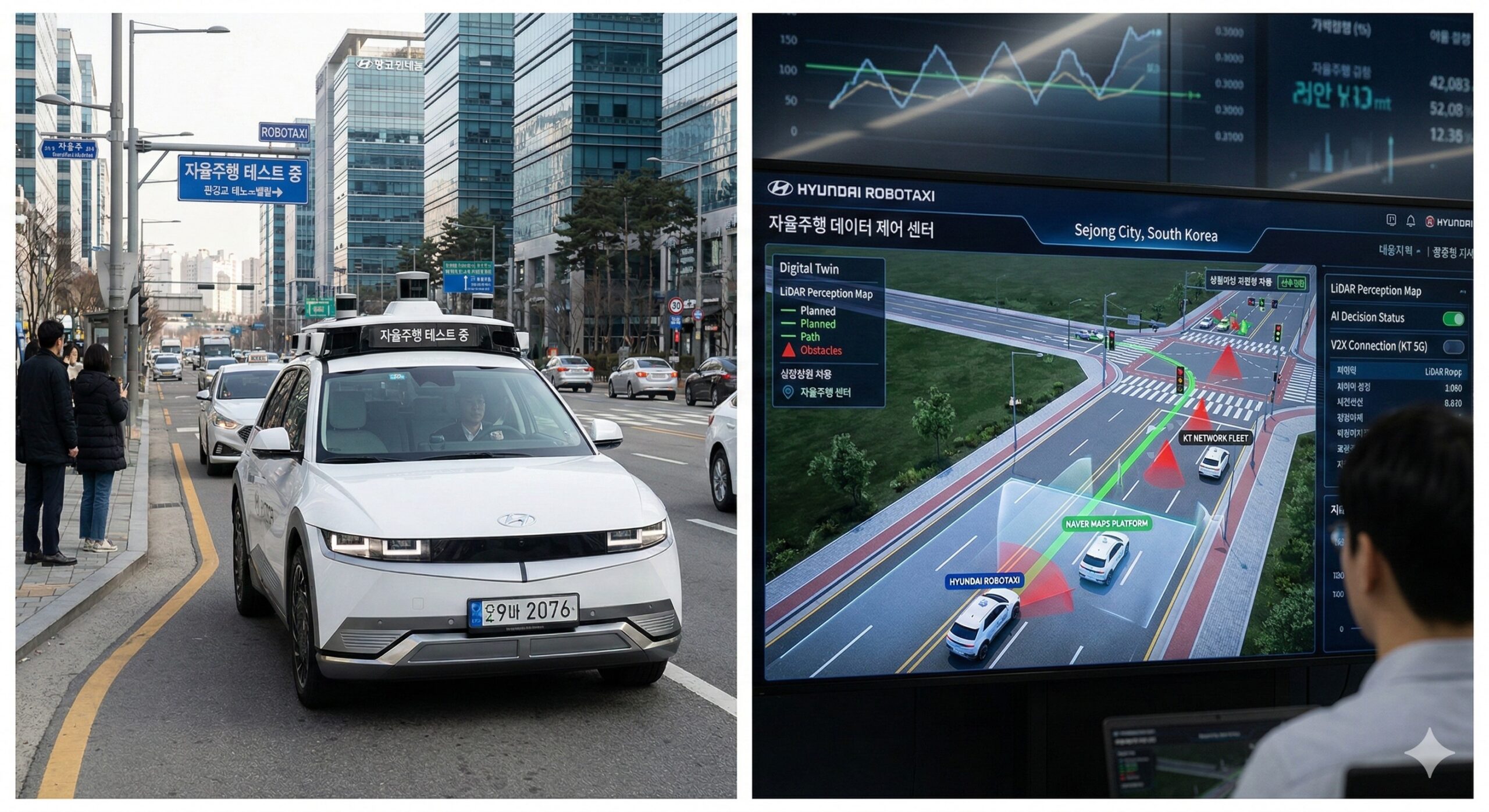
South Korea’s autonomous vehicle industry is approaching a critical inflection point in 2026, as Level 4 self-driving pilot services expand across Sejong, Pangyo, and Busan. While the underlying technology has matured considerably, regulatory gaps and inter-industry conflicts are emerging as the decisive variables that will determine the pace of full commercialization.
Automation Impact: Reshaping Mobility Through Driverless Operation
Level 4 autonomous driving — which enables fully self-directed operation within designated zones without driver intervention — holds significant promise for reducing accidents caused by human error, the leading factor in most traffic incidents. Core enabling technologies including AI decision algorithms, high-definition mapping, and V2X (Vehicle-to-Everything) communication infrastructure are advancing rapidly, supported by real-world data accumulating across pilot regions. Against a backdrop of driver shortages and an aging workforce in the transportation sector, autonomous mobility automation is increasingly viewed as a structural solution to ensure stable, scalable mobility supply.
Operational Efficiency: Three Strategies, One Ecosystem
South Korea’s three leading players are pursuing distinct but complementary automation strategies. Hyundai Motor is integrating robotaxi services, autonomous software development, and EV platforms into a unified “hardware-plus-service” model aimed at owning the full mobility value chain. Naver is positioning autonomous vehicles as “moving data platforms,” combining precision mapping, cloud infrastructure, and AI to build a software-centric ecosystem with adjacencies to robotics and AI agents. KT is carving out the role of a “network-layer operator,” leveraging 5G and V2X-based fleet management systems to control the operational backbone of autonomous mobility. Together, these approaches represent a strategic division of labor across hardware, data, and network dimensions — each competing to define South Korea’s autonomous driving architecture.
Safety Considerations: Balancing Technological Advancement with Risk
Safety validation remains a shared challenge globally. In the United States, Waymo’s 5th-generation autonomous driving system came under scrutiny by the National Highway Traffic Safety Administration (NHTSA) following safety incidents reported after the system began real-road operations. In South Korea, ambiguous safety certification standards and an unresolved accident liability framework are widely identified as substantive barriers to commercialization. South Korea was the first country to establish Level 3 safety standards and has since introduced a performance certification and conformity approval system for Level 4 vehicles — yet insurance frameworks and liability attribution remain in conflict with existing laws.
Cost Analysis: Operational Savings vs. Societal Transition Costs
Autonomous taxi platforms offer compelling unit economics through the elimination of driver labor costs, a key argument advanced by platform operators. However, the full cost picture is considerably more complex when accounting for workforce displacement impacts, safety infrastructure investment, and regulatory compliance expenditures. The government faces the difficult task of mediating between platform companies advocating for data-driven dynamic pricing and incumbent taxi operators seeking to preserve fixed fare structures — a conflict with no easy resolution.
Deployment Outlook: A Defining Moment for the Korean Mobility Model
Level 4 pilot operations are currently underway across Sejong, Pangyo, and Busan, with the government also advancing plans for an autonomous driving demonstration city in Gwangju. Industry observers broadly agree that while the technology is ready, genuine commercialization requires regulatory reform and social consensus to keep pace. Whether autonomous driving becomes South Korea’s next major growth engine or a catalyst for prolonged social conflict will ultimately hinge on the speed and quality of regulatory innovation and stakeholder alignment.